
%20(2).jpg "What Is Cut and Sew All Over Print? (And How It Differs From DTG)")
Cut and sew all over print (AOP) means the fabric is printed flat, then cut into panels and sewn into the finished garment. Every surface — front, back, sleeves, collar — can carry the design. DTG (direct to garment) works the opposite way: the finished garment goes into a printer, and ink is applied to a defined print area, typically the chest. The construction method is the fundamental difference, and it shapes everything from product type to care instructions.
A manufacturer starts with rolls of fabric. In cut and sew production, that fabric is printed first, then cut into panels using a template for each size, then sewn together. The result is that print coverage has no boundary: every panel, from body to sleeves to cuffs, is printed edge to edge.
The practical consequence is that the design file cannot be a single image. A hoodie might require eight or more separate panels: front body, back body, two sleeves, hood outer panels, pocket, cuffs, waistband. Each panel gets its own section of the artwork, printed edge to edge with bleed so no blank fabric shows at the seams. The panels are separate pieces of a flat file, not one continuous image: artwork is not expected to line up across seams, and good designs are chosen so that does not matter.
This is also why sizing is more complex than it looks. A small and a 3XL are not the same shape. If you scale one flat file up, the design proportions distort on the larger garment. Proper cut and sew production generates a separate print layout for each size so the design scales correctly with the garment rather than just getting bigger or smaller as a flat image.
DTG prints on a finished, sewn garment. The garment is laid flat on a platen, a print head passes over it, and ink is deposited onto the surface. The print area is constrained by the platen size — typically about 40 x 50 cm for a full front print — and limited to flat, accessible surfaces. Sleeves, collars, side seams, and hoods are not reachable.
DTG is well suited for placement graphics: a logo on the chest, a graphic on the left hem, a back print. The file setup is straightforward, the turnaround is fast, and it works on cotton, which most customers still associate with a quality feel in casual wear. If a customer wants a soft cotton t-shirt with a single-color logo, DTG or screen print is the right tool. Cut and sew AOP is not.
.webp)
For a cotton feel, sublimation-based AOP is genuinely the wrong approach — the fabric has to hold the dye, which means polyester. Sending customers toward a DTG cotton tee when that is what they actually want is the honest answer, and it matters for setting expectations correctly.
In DTG, there are no seams inside the print zone. In cut and sew, every seam is a join between two separately printed panels. A pattern cannot continue across a side seam. A wave graphic on the front will not meet its continuation on the back: panel proportions change with every size, so an alignment drawn for one size would be wrong on all the others. AOP designs are made with this in mind, using artwork that reads well on each panel on its own.
What the software and the designer must account for instead is seam allowance: the strip of fabric that gets folded inward and stitched. That strip does not show on the finished garment, so any design element that lands inside the seam allowance disappears. A designer who places a critical element too close to a panel edge will lose it in production.
This is one of the specific problems product creator software addresses in cut and sew workflows — showing designers where the seam allowance falls so elements can be placed outside it, and previewing where the seams will fall on the finished garment.
.webp)
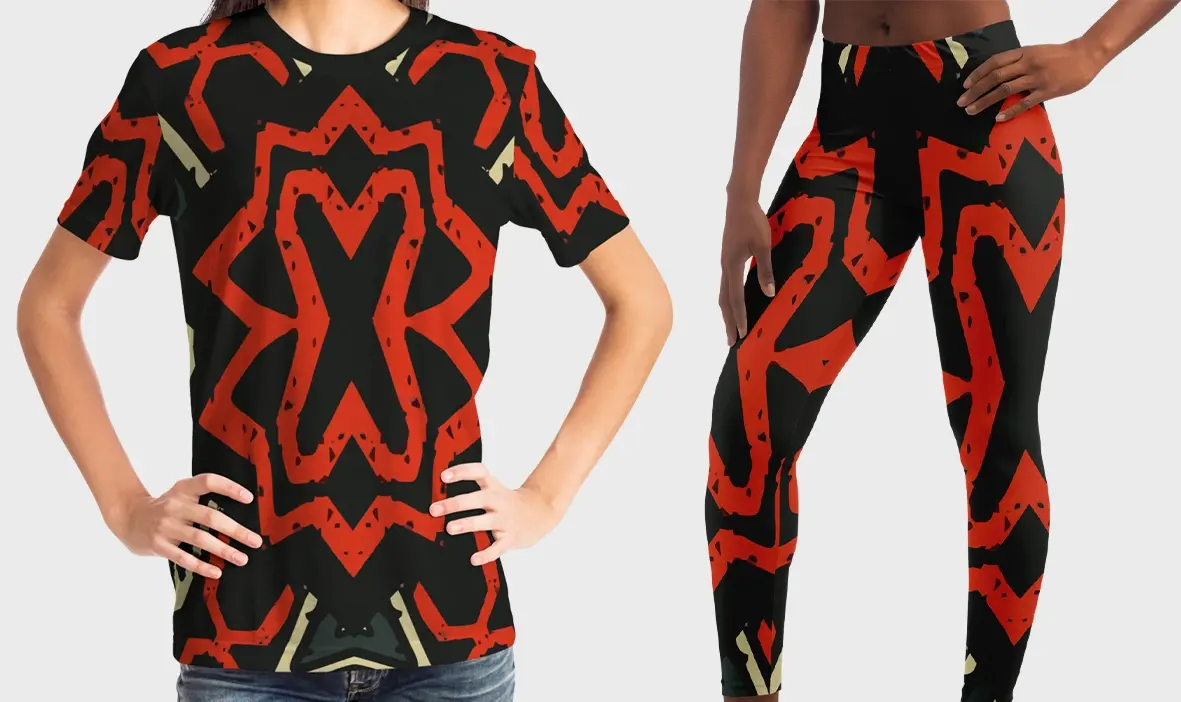
The category exists because certain garments simply cannot be made well with a placement print. Leggings need print on every surface, including the waistband and inner leg, which a flat platen cannot reach. Swimwear needs print on every panel, front and back, with no blank areas. Soccer jerseys, basketball jerseys, and baseball jerseys all rely on bold full-garment graphics where a chest-only print would look incomplete.
Hawaiian shirts — button-down woven prints — are another example. The pattern on a proper Hawaiian shirt continues across the button placket and pocket, matching the front panel. That alignment is only achievable if the placket and pocket are cut from the same printed panel as the front body, or if the print positions are mapped carefully before cutting.
Hoodies, zip hoodies, rash guards, and one-piece swimsuits are all common cut and sew AOP products. The design versatility is genuinely different from what DTG allows: a seller can put the same underwater scene on leggings and a matching sports bra so the two read as one coordinated set.
Historically, cut and sew AOP required minimum order quantities — often hundreds of units — because the setup work per size and per panel made small runs uneconomical. Print-on-demand suppliers have changed that by absorbing the setup work into their production systems and producing single units profitably at scale.
For a Shopify seller, this means a store can list a full-coverage sublimation legging or a Hawaiian shirt without holding any inventory. An order comes in, the supplier prints, cuts, and sews that single unit, and ships it. Subliminator, for example, specializes in this category with 150+ cut and sew AOP products, no minimums, and full white label production including custom printed inside labels.
The trade-off is delivery time. Cut and sew is more production-intensive than picking a pre-sewn blank off a shelf and running it through a DTG printer. Production typically takes 4 to 7 business days, and standard US delivery runs about two weeks door to door from order placement. That is longer than some DTG print-on-demand timelines, and sellers should factor it into their customer communications.
This article focuses on the construction difference between cut and sew and DTG. If you want to understand how sublimation dye transfers into polyester fiber at a molecular level — why the print does not sit on top of the fabric and therefore cannot peel or crack — the earlier article What is Cut and Sew Sublimation? covers that process in detail.
Not with sublimation dye — sublimation requires polyester because the dye bonds into the synthetic fiber through heat. Some suppliers offer direct-to-fabric printing on cotton-blend fabric, but this is a different process with different durability characteristics and is not standard cut and sew sublimation AOP. If you specifically need cotton, DTG placement printing is the more practical option.
For professional cut and sew production, yes. Each size has different panel dimensions, so a correctly produced AOP garment uses size-specific print layouts to keep the design proportional across sizes. Some product creator tools handle this automatically by generating the correct panel layout when you place your artwork.
No. Artwork does not line up across seams on AOP garments: every size has its own panel proportions, so a match drawn for one size would be off on all the others, and designs are made so it does not matter. The narrow exceptions are specific software features, such as pocket matching to the hoodie front panel or the overlapping placket on baseball jerseys. It is still worth checking whether the product creator shows you where seams will land before you place an order.
Generally yes, per unit. The production is more labor-intensive — multiple panels are printed, cut, and sewn individually. DTG requires only loading a finished blank into a printer. For products like leggings, swimwear, or jerseys where full coverage is the point, there is no DTG equivalent; the comparison only applies to garments like hoodies or t-shirts where both options exist.
Sublimation is a printing process — dye is transferred into polyester fiber using heat and pressure. All over print describes coverage — print that spans the entire garment rather than a defined placement zone. Most cut and sew AOP uses sublimation as the printing method, but the two terms describe different things: one is how the print is applied, the other is how much of the garment it covers.

E-commerce enthusiast & founder @ Subliminator.

