
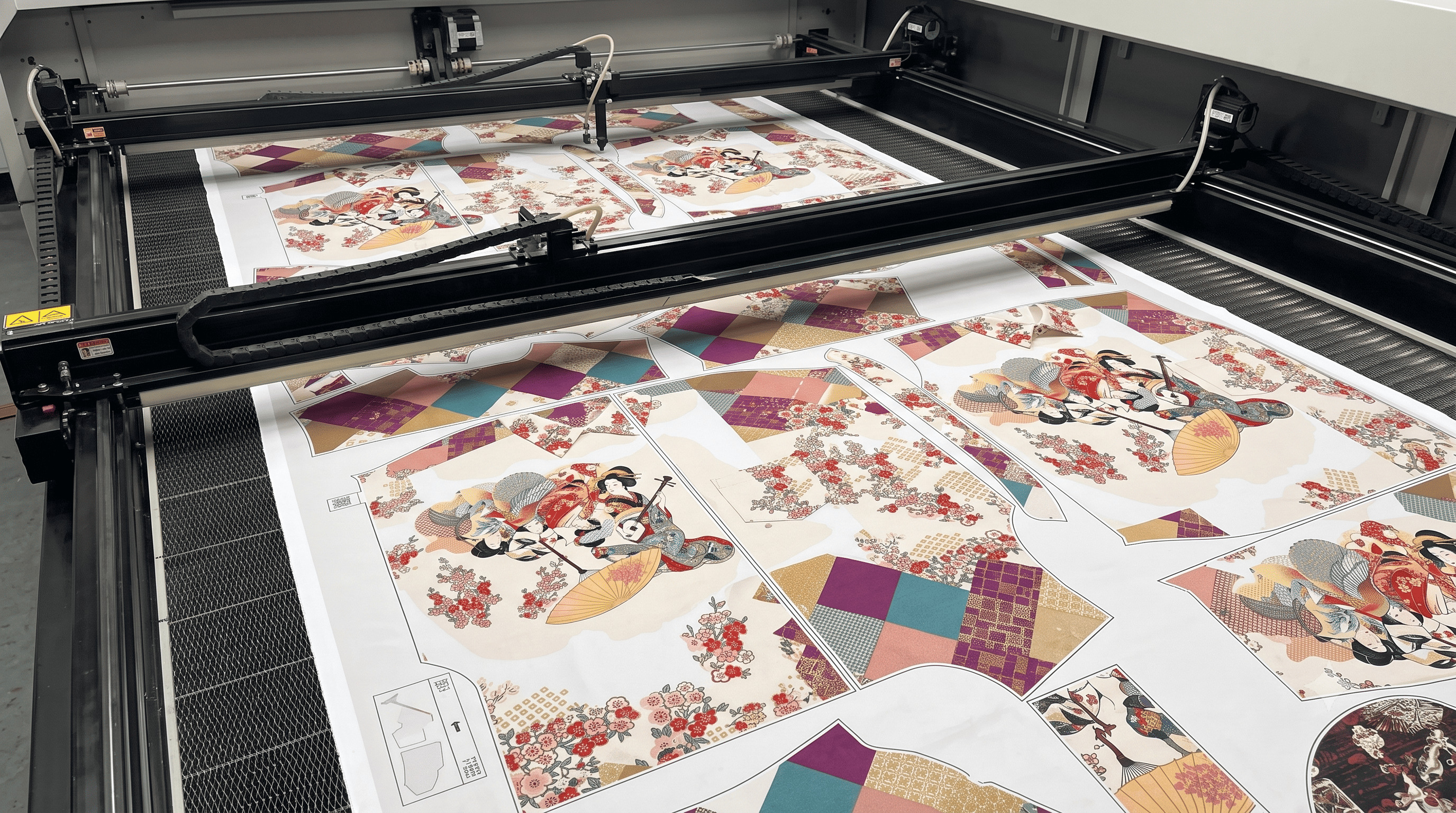
All-over-print cut and sew products are made in multiple countries regardless of which supplier you use. Blank components, fabric, and final assembly often happen in different locations, and no major supplier operates entirely in one country.
What separates good suppliers from unclear ones is whether they state their production locations openly and what the actual delivery timelines are.
Cut and sew AOP supply chains are global by design, not by accident
The right question is not "which country" but "does the supplier publish that information and back it with real timelines."
All-over print (AOP) means the design covers the entire surface of a garment, with every panel printed edge to edge. That is a different process from a placement print, where ink is applied to a pre-sewn blank in one area.
There are two main methods used at scale today.
Sublimation printing bonds dye directly into polyester fabric before or after cutting, which is why sublimation prints never peel, flake, or crack — the dye is part of the fiber, not sitting on top of it.
Direct-to-fabric printing works similarly but can be applied to cotton-blend fabrics. Cut and sew refers to the construction step: panels are cut from printed fabric and sewn into a finished garment. This is why cut and sew AOP is more production-intensive than a placement print on a pre-made blank.
For a cotton feel, sublimation is genuinely not the right tool. The process requires polyester to bond correctly. If your customers want a heavy cotton tee with a full-coverage print, direct-to-garment or direct-to-fabric printing on a cotton blank is a better fit, and several suppliers offer that separately.
You can read more about their difference in our dedicated article.
Cut-and-sew AOP involves more steps than most people expect. A finished hoodie, for example, passes through fiber production, fabric weaving or knitting, dyeing or coating, printing, cutting, sewing, labeling, quality control, and fulfillment. Each step has its own geography, driven by cost, specialized equipment, and available labor.
Polyester fabric is produced at scale in China, Taiwan, South Korea, and parts of Southeast Asia. Blank garment components — pre-cut panels or full blanks — are sourced from wherever a supplier has negotiated capacity. Assembly (the actual sewing) happens wherever the supplier has its production facility, which for most AOP suppliers is not the same country as the fiber source.
This is not a corner-cutting arrangement. It is how apparel manufacturing has worked for decades across every price point. The question worth asking is whether a supplier is transparent about it.
According to Printful's public catalog (July 2026), their core AOP range is sewn in the United States and in Latvia for European fulfillment. The blank components used in that range are sourced mostly from Mexico and China. Thirteen construction-heavy items in their catalog — including polos, windbreakers, pajamas, track pants, and board shorts — are fulfilled only from China. Printful also offers a newer cotton AOP line, which is US-fulfilled using blanks sourced from Mexico.
So depending on which Printful product you are selling, it may be sewn in the US, in Latvia, or in China, from components that originated somewhere else. None of that is unusual. It is just the reality of the category.
Subliminator produces in China. That is stated plainly. Production typically takes 4 to 5 business days. US delivery on the standard shipping lane is typically about 14 days door to door; express is typically about 9 days. EU and Australia standard are typically about 15 days; Canada express runs about 9 days, which is the fastest lane in the network.
One production detail worth knowing: Subliminator uses color-matched stitching on all apparel. Thread color is matched to the dominant color in the design so seams blend into the print rather than cutting across it.
.webp)
That matters most on designs with large continuous color fields — a dark navy graphic that runs across a shoulder seam will show a white or black thread line as a hard interruption if the thread is not matched. Printful's public catalog lists stitch color options as white or black only (source: Printful public API, July 2026).
Each size in the Subliminator range also gets its own print panels rather than scaling a single panel up or down. This keeps graphic proportions consistent across sizes — a design element that should sit at chest height on a medium does not drift toward the collar on a 4XL.
Not automatically. Quality in cut and sew AOP depends on the precision of the cut panels, thread tension during sewing, print registration at seam allowances, and how well the design was set up for the specific construction. Those factors exist at factories in every country.
What domestic fulfillment does offer is faster delivery to domestic customers and, for some brands, a marketing angle around local production. Whether that is worth a higher product cost depends entirely on your margins and your customers' priorities.
For sellers focused on full-coverage activewear, swimwear, and sportswear — categories where sublimation on recycled polyester is the standard approach — the production location matters far less than whether the panels are cut accurately, the seams are flat, and the print is consistent across the garment.
When evaluating any AOP supplier, these are the practical questions:
Supply chain geography is one input. It is rarely the deciding factor.
Production location is not a reliable quality signal on its own. Cut construction, thread quality, print precision, and quality control processes determine the finished product, and those vary by factory and supplier regardless of country. The better question is whether a supplier publishes fabric specs and has a stated process for handling defects.
Sublimation dye bonds chemically with polyester fibers. On cotton, the dye does not bond the same way, so colors fade faster and coverage is less complete. Direct-to-fabric printing can work on cotton blends, but it is a different process. Most full-coverage athletic and swimwear AOP is polyester for this reason, not just cost.
No. White label means the supplier's branding is removed and replaced with yours. Subliminator produces with custom printed inside labels on most apparel, so the label your customer sees carries your brand, not the production partner's name.
For Subliminator, production typically takes 4 to 5 business days, and US standard delivery is typically about 14 days door to door from order placement. Express typically runs about 9 days. These are medians across a large order sample; nine out of ten US standard orders arrive within about 3 weeks of ordering.
Yes. Subliminator has no minimums, so a single-piece sample order (with a 10% discount) is possible. That is the practical way to evaluate print quality, seam construction, and fit before listing a product.

E-commerce enthusiast & founder @ Subliminator.
